
Host Resources
Writing a Clear Property Description: What Guests Actually Need to Know
Turn a room-by-room property audit into clear guest-facing copy that explains fit, layout, sleeping arrangements, access, shared areas, and limitations.

A clear vacation rental property description helps a guest decide whether the real space fits the trip. It should explain who the home suits, how the rooms connect, where people sleep, which areas are private or shared, what access feels like, and which practical limitation could change a booking decision. It should not repeat every form field, hide an awkward feature, or promise an experience the property cannot provide.
Write from a room-by-room audit, not from adjectives. Compare the fixed facts with the photographs and structured fields, draft around guest fit, and preview the result beside the home. Useful short stay listing content reduces guessing; decorative copy makes the same uncertainty sound warmer.
Build a vacation rental property description from facts
Begin with three groups of evidence. First, record facts represented elsewhere: property type, capacity, rooms, beds, amenities, rules, and location context. Second, note relationships that isolated fields cannot explain, such as a bedroom reached through another room or a shared courtyard beside the entrance. Third, list conditions a suitable guest should understand before booking.
Structured facts
Consider it for: Counts, selectable amenities, sleeping-space records, rules, timing fields, and other details the listing already presents consistently.
Verify: Keep those fields accurate. Do not use the description to contradict a room count, invent an amenity, or bury a different capacity in prose.
Useful context
Consider it for: Explaining layout, circulation, privacy, shared spaces, everyday routines, and how the recorded features work together.
Verify: Describe only what a guest can actually use. Avoid assumptions about how every traveller will experience the home or neighbourhood.
Material limitations
Consider it for: Making stairs, compact rooms, noise context, shared entrances, restricted areas, or another decision-shaping condition understandable.
Verify: Use plain language and the appropriate listing fields or photographs as well. A positive adjective should never cancel an important fact.
Use the opening lines to explain guest fit
The first two or three sentences should identify the bookable space, its broad setting, the sleeping pattern, and the kind of routine it supports. For example, a self-contained apartment with two separate bedrooms communicates something different from a private room in a home with shared facilities. Keep the statement factual enough that a guest can test it against the gallery and property overview.
Good host copywriting tips are usually editing rules: prefer concrete nouns and verbs, remove praise that no feature supports, and replace “perfect location” with the public area context the guest is allowed to see. Do not publish an exact hidden address, private arrival instruction, phone number, or contact route in promotional copy. Keep sensitive details inside the controlled booking workflow.
- Name the actual space: apartment, villa, room, guesthouse, chalet, hotel room, or another supported property type.
- Summarise the sleeping arrangement without replacing the recorded bed and room details.
- State whether important spaces are private, shared, or outside the bookable area.
- Describe the broad public setting without publishing a private address or promising an exact travel time.
- Save atmosphere for one supported sentence after the practical fit is clear.
Use the broader Host readiness checklist to confirm that authority, account review, location, photos, rates, and availability are being handled as separate responsibilities. A polished description cannot make an incomplete listing ready for review.
Walk the property before writing the middle
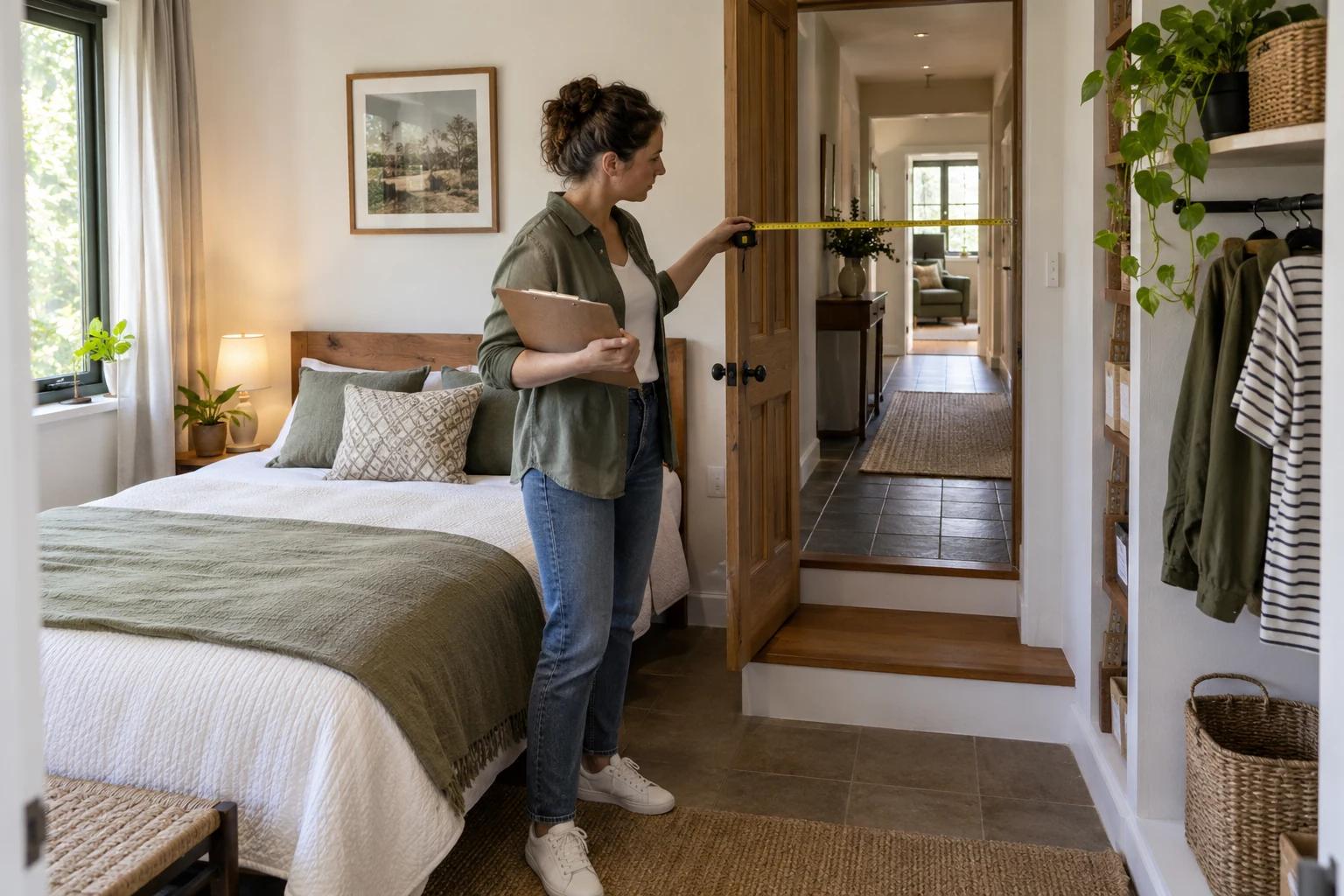
Walk from the entrance through every guest-accessible space. Record steps, internal levels, room connections, storage, sleeping areas, bathrooms, cooking or dining areas, and shared thresholds. Notice the facts that a cropped photograph or isolated amenity label may leave unclear.
An apartment listing description becomes useful when it connects the plan. Explain whether bedrooms are separate, whether a bathroom is reached from a common area, whether a sofa bed changes how the living room functions, and whether guests cross a shared space to enter. If a physical dimension matters, verify it accurately before publishing rather than estimating from memory.
- Trace the luggage route from the relevant entrance to the sleeping area.
- Match every described room and sleeping space to the current property record.
- Identify which facilities belong only to guests and which are shared with a Host, neighbours, or other units.
- Check whether stairs, thresholds, narrow passages, internal levels, or parking arrangements need clearer context.
- Remove any sentence that describes a planned renovation, borrowed item, nearby facility, or locked area as part of the stay.
Coordinate the description with photos and listing fields
The description, photographs, amenity selections, sleeping-space records, rules, and public location should tell one compatible story. Photos show appearance within the frame, structured fields make facts scannable, and the description explains context. Repetition adds length without adding certainty.
Use the property photography guide to make the gallery cover the actual bookable space. Then apply the guest-side listing evidence checklist as an editorial test: can a reader understand capacity, layout, access, amenities, location context, and terms without filling gaps with assumptions? If the copy and evidence disagree, correct the underlying listing rather than writing around the conflict.
Keep in structured fields
Consider it for: Room counts, bed types, amenity selections, rules, arrival fields, stay limits, and other values with dedicated controls.
Verify: Review the live field as the authoritative place for that detail and make sure the prose does not state something different.
Explain in the description
Consider it for: How spaces connect, who may share them, what daily use feels like, and why a recorded feature matters to a particular trip pattern.
Verify: Keep context concise and factual. Do not turn an interpretation into a guaranteed outcome for every guest.
Show with current photos
Consider it for: Room condition, furniture placement, circulation, sleeping setups, views, steps, and the visual relationship between guest spaces.
Verify: Use current images of this property only, protect private information, and disclose material details that the gallery cannot show clearly.
Edit out vague, duplicated, and unsupported claims
Read each sentence and ask what decision it supports. “Beautiful,” “spacious,” “central,” “quiet,” “luxurious,” and “fully equipped” are judgments unless the copy supplies accurate context. Replace them with observable facts or delete them. Do not borrow a nearby landmark’s appeal, imply uninterrupted views, or promise silence, transport convenience, or neighbourhood conditions that the listing cannot establish.
- Replace “spacious” with the actual room relationship, capacity, or verified dimension when a dimension is genuinely useful.
- Replace “central” with the approved public area or neighbourhood context; do not invent walking or driving times.
- Replace “fully equipped” with the amenities selected and available for every eligible booking.
- Replace “private” with the specific entrance, room, bathroom, kitchen, or outdoor area that is not shared.
- Delete “perfect for everyone” and state the routines or group needs the real layout supports.
Preview the guest view and maintain the promise

Open the property editor and use its private guest preview while the listing is still a draft. Read the description beside the title, property facts, sleeping arrangement, amenities, gallery, public map context, and policies. Check it at desktop and phone width. The combined page should answer the central questions without exposing private information or forcing the guest to reconcile contradictions.
- Read the draft aloud once to catch long, promotional sentences and missing words.
- Confirm every claimed space, amenity, view, access feature, and sleeping arrangement against the current home.
- Check that photographs and room labels support the copy without revealing an exact address or personal data.
- Remove duplicated facts when the dedicated field already communicates them clearly.
- Update the description when layout, access, privacy, furniture, guest areas, or another material condition changes.
The public ShamStay Host guide explains the wider onboarding and property-review path. If the current editor cannot represent an important condition accurately, pause the submission and contact ShamStay support rather than omitting the detail or placing private information in the description.
Practical answers
Frequently asked questions
How long should a vacation rental property description be?
Use enough space to explain guest fit, layout, privacy, shared areas, access, and material limitations without repeating every structured field. The useful test is whether a guest can understand the property without guessing, not whether the draft reaches a particular word count.
Should I repeat every amenity in the description?
No. Keep the complete, current set in the listing’s amenity controls. Mention an amenity in prose only when its placement, sharing arrangement, limitation, or relationship to the rest of the space needs useful context.
What should I say about the neighbourhood?
Use the approved public area context and describe only relevant, supportable characteristics. Do not publish an exact hidden address or promise journey times, noise levels, access, parking, or nearby services that have not been verified and represented appropriately.
When should I update the property description?
Review it whenever the layout, sleeping setup, furniture, access, privacy, shared areas, amenities, rules, or guest-use spaces change. Update the related fields and photographs at the same time so the published listing continues to describe one current property.